

Sunshine continues to review several extraction techniques for development of our resources. These range from the widely used methods of Steam Assisted Gravity Drainage (SAGD) and Cyclic Steam Stimulation (CSS) and more experimental techniques, all described below.
We are focused on the application of proven technology, but are aware of rapid advancements in technology associated with Canada's oil sands deposits and are considering all reasonable methods that can result in the lowest cost and most efficient production of reserves.
Oil Sands Extraction
The Corporation continues to review several potential extraction techniques for development of its resources. These range from the widely-used methods of Steam Assisted Gravity Drainage ("SAGD") and Cyclic Steam Stimulation ("CSS") and more experimental solvent techniques. The Corporation is focused on the application of proven technology, but is aware of rapid advancements in technology associated with Canada's oil sands deposits and is considering all reasonable methods that can result in the lowest cost and most efficient production of reserves. The brief discussion below summarizes employable bitumen extraction technologies.
Steam Assisted Gravity Drainage
SAGD was developed in the 1980s by an Alberta government research center and fortuitously coincided with improvements in directional drilling technology that made it quick and inexpensive to do by the mid-1990s. In SAGD, two horizontal wells are drilled in the oil sands, one very near the bottom of the formation and another about five meters above it.
These wells are typically drilled in groups off central pads and can extend for 800 to 1,000 metres in any direction. In each well pair, steam is injected into the upper well and the heat mobilizes the bitumen, which allows it to flow into the lower well, where it is pumped to the surface. SAGD has proved to be a major breakthrough in production technology since it allows very high oil production rates and recovers greater than 60% of the oil in place. Most major Canadian oil companies now have SAGD projects in production or under construction in Alberta's Athabasca oil sands area. Examples include Japan Canada Oil Sands Ltd.'s (JACOS), Suncor's Firebag and MacKay River projects, Nexen's Long Lake, Husky Energy's Tucker Lake and Sunrise projects, Encana's Foster Creek and Christina developments, ConocoPhillips Surmont and the Devon Canada's Jackfish project.
Cyclic Steam Stimulation
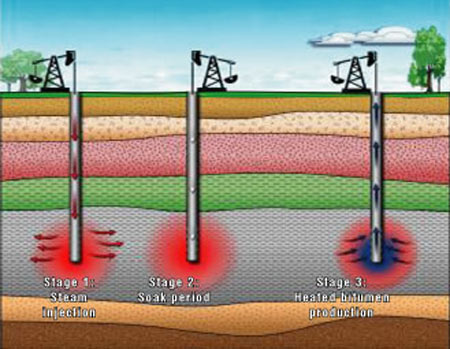
Steam injection for recovery of heavy oil has been in use in oil fields of California since the 1950s. The CSS or "huff-and-puff" method has been in use by Imperial Oil at Cold Lake since the 1980s and is also used by Canadian Natural Resources at Primrose and Wolf Lake and by Shell Canada at Peace River. In this method, the well is put through cycles of steam injection, soak and oil production. First, steam is injected into a well at a temperature of 300 to 340 degrees Celsius for a period of months. Then, the well is allowed to sit to allow heat to soak into the formation. Later, the hot oil is pumped out of the well for a period of months. Once the production rate falls off, the well is put through another cycle of injection, soak and production. This process is repeated until the cost of injecting steam becomes higher than the net revenue from producing the recovered oil. The CSS method is capable of achieving recovery factors of around 20% to 25%.
Solvent Process
The Solvent Process is similar to SAGD but instead of steam, hydrocarbon solvents are injected into the upper well to dilute the bitumen and allow it to flow into the lower well. It has the advantage of much better energy efficiency than steam injection and it achieves some partial upgrading of bitumen to oil right in the formation. This new technology has attracted much attention from oil companies who are beginning to experiment with it.
Combined Recovery Methods
The above three methods are not mutually exclusive. It is becoming common for wells to be put through one CSS injection-soak-production cycle to condition the formation prior to going to SAGD production, and companies are experimenting with combining solvent with SAGD to improve recovery rates and lower energy costs.